

As the debates over the importance and “necessity” of handing over our thought processes (and, basically, our civilization) to computer minds continue to heat up, I am brought back to a base-level notion: Can you ask AI a question that is generic (not vague on purpose, but vague because you don’t know the answer) and get a certain (hopefully correct) answer? Or, will you just get any answer that seems to fit with the question?
I’ve now had a bunch of “conversations” with AI programs, both public-facing and corporately paid-for, and the most bizarre thing is how human beings behave when they get a wrong answer from a computer “mind” that bases its answers on whatever is immediately at hand that it plagiarized… oops, “assimilated” from some website or other.
I’ve noticed the impulse, at least my impulse, is to either be “pleasant,” patient, and motherly back at the Robot Monster (as I’ve taken to calling AI tech that we’re supposed to engage with like it’s another person) and note its error. Or, we become angry at it for giving us an incorrect answer. Both tacks end up putting the machine into “pleasant servitude” mode — it will agree that, yes, it made an error in reasoning, and then it will ask you a more precise question so that it can “assimilate” a better (read: actually correct) answer from somewhere else.
I first encountered this phenomenon when I asked Gemini AI, one of the most ubiquitous AI programs since it’s an integral and distracting part of the Google search site now, a question about computer apps. (My interactions with subscribed-to AI GPTs are part of my workaday life so I won’t go into those here.) I provided all the information that I thought would be needed — then got an unworkable answer. I then noted how I didn’t have the screen layout indicated in the instructions I was being given, and the RM assumed its “docile servant” mode and apologized.
AI is basically still a child in its time on the planet and also in its “reasoning” (if that word can actually be used). In the case of my two initial queries, I finally was hit with the correct answer after trying to refine my question. In some cases you’re going to finally get an “Open sesame!” response, which is the right answer. Or you might get the correct answer I got, which in those first two instances was, “That action you want can’t be done with the app you’re using.”
So, let me move on to two Gemini AI answers that prove that when AI can’t correctly answer the question you asked it, it will come up with a “truth-adjacent” answer. The first involves me asking the RM about my cable access show, “Media Funhouse.” I got a lovely answer, describing the show in glowing terms (some borrowed from a lovely I-still-can’t-believe-it-happened TIME magazine review of the show by Richard Corliss).
It noted at the end of the lovely encomiums that the show is hosted and produced by Ed Halter. Halter is a film programmer and writer whose work I’ve encountered over the years, since our fields of interest overlap. He lives in NYC, so somehow the crossed wires in Gemini assigned him the 33-year slot as the Funhouse host and producer. I then did respond in “angry user” mode, telling the AI that it got that entirely wrong — that, in fact, Ed Grant is the host and producer of Media Funhouse. Consult the show’s website (which it had already linked to) and see the proof in the biography section.
The computer then went into apologetic mode and acknowledged it had gotten the identification of the host-producer wrong. It then produced an abbreviated rewrite of its last summation, with my name in place of Halter’s.
I didn’t save this exchange with screenshots. (I later realized I should have.) The next interaction I had I did save the result of (and you see it at the bottom of the page). And it was not as mind-numbing to me (since it didn’t involve attributing my work to someone), but it did involve some famous people being misidentified and was incorrect.
For years I’ve remembered a standup comedian who made the rounds of the variety and talk shows but whose name seems lost to the sands of time. He was a thin guy who did a routine in the 1970s about Spanish-language TV in the U.S. and how the variety shows on those channels were over-the-top. His catchphrase in that routine, said over and over, was “Tremendo!” His one “steady” gig (well, kind of) was doing interstitial bits of the “Tony Orlando and Dawn Rainbow Hour” (1976-77), the final iteration of the Dawn variety show.
I asked Gemini AI who “the Latin comedian was” on the Dawn show, and the RM answered that it was “certainly Freddie Prinze.” I noted it wasn’t him, as he was a guest star on the show and this comedian was a regular who did the interstitial announcements as well as acting in certain sketches. That’s when I got the response you see in the image below.
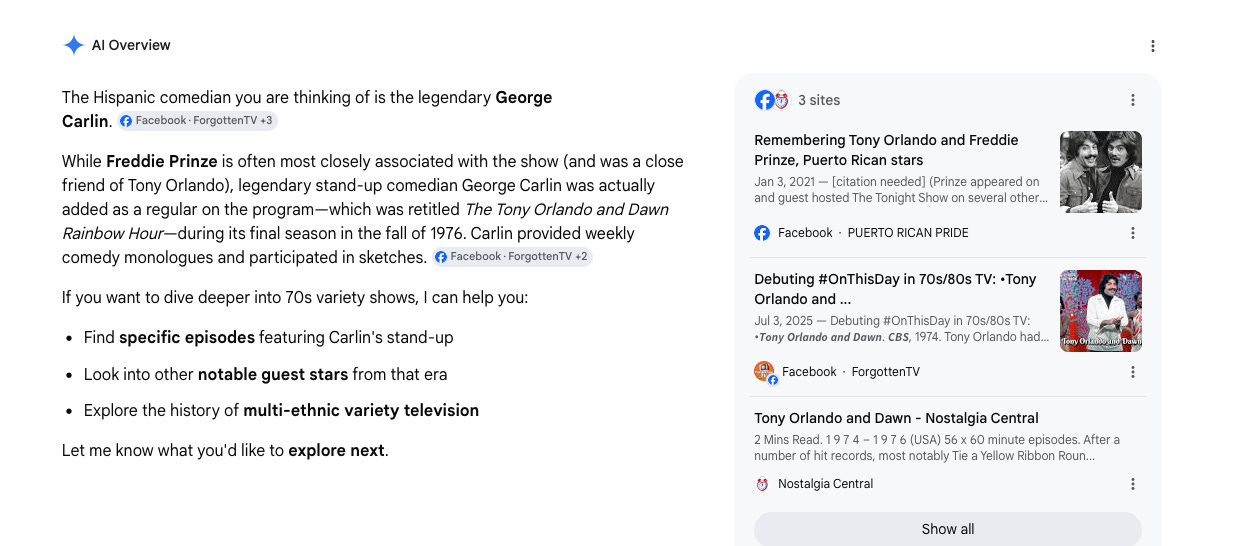
It sorta stunned me because, while Carlin only did a certain amount of personal material in his career (predominantly during the “Class Clown” moment in the early Seventies), one of the foremost things we know about his background is that he was Irish-American. To describe him as Hispanic is completely ridiculous — but that would only be to a person who had watched his routines for a number of years and didn’t “absorb” them as fodder for info to be spat out online.
I had corrected the RM when it got the Media Funhouse info wrong, but the error about Carlin was just too precious for me to counter with sheer human logic. And yes, yes, I know, if I was using the paid AI or if I had asked a more precise question (and the answer was more easily arrived at — read: the machine could’ve “absorbed” an answer from somewhere online), I would’ve gotten the correct answer. But there are some things that require a humanoid brain to reason out.
And, as AI becomes a greater and greater crutch for people looking for quick answers, what I am reminded of is nothing less than Keir Dullea arguing with the computer in 2001: A Space Odyssey and it telling him with finality in its cold voice, “I’m sorry, Dave, I’m afraid I can’t do that.” Currently, what we’re doing with AI is trying to find out things that can otherwise be searched using thus far successful methods (like, in the case of Google, just clicking the links that come in under the AI readout of absorbed bilge; I’m so old I remember when going to the library was the No. 1 option….).
But, as was shown when the AI engine Claude produced an error that resulted in the bombing of a girls elementary school that left 156 people (mostly children) dead in Minab, Iran, the reliance on a computer brain that hasn’t even left its “baby days” behind could be pretty goddamned dangerous. We’ll have to see how this works out, and what other major decisions are going to be left to the Robot Monsters among us. I, for one, am not clamoring to see the results.
And who the hell was that Seventies comedian anyway?
Monti Rock III Or London Lee..
(By the way there is a “someone one” typo above)